October 30, 2026
Viktor Boichuk at the Forbes “Private Investments” Conference
#S1 REIT

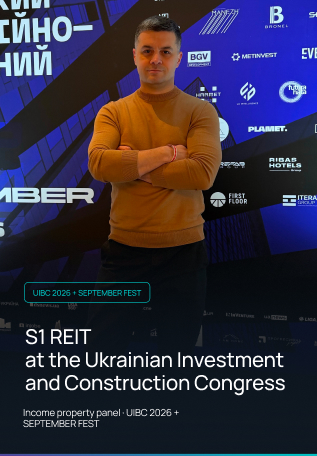
On October 27, Kyiv hosted the Forbes Ukraine “Private Investments” conference, dedicated to investment strategies, wealth management and risk assessment. S1 REIT Chief Commercial Officer Viktor Boichuk took part in the expert panel “Where’s the Profit? A Hard Look at Real Estate Investments.”
Together with Ihor Farberov, co-founder of the ULIS chain of suburban residential complexes, and Nataliia Zhuravlova, co-founder and managing partner of SHELEST, Viktor discussed various formats of income-generating real estate, sources of returns, risks for investors and market prospects for 2026–2027. The discussion was moderated by Dmytro Struk, Development Director at Kreator-Bud.
Three key parameters for evaluating investments: return, risk, liquidity
One of Viktor’s key points concerned the investment appeal of different real estate formats. Any investment should be analyzed against three core parameters: return, risk and liquidity.
Return defines the potential financial outcome of an investment, risk is the likelihood of losing capital or earning less than expected, and liquidity is the ability to get the invested funds back quickly.
According to Viktor Boichuk, collective investment through specialized real estate funds has advantages over owning individual properties directly. In particular, professional management makes it possible to operate assets more efficiently and increase their returns.
Another advantage is the option of an early exit. Unlike selling an apartment or commercial premises, which may require a lengthy search for a buyer, a fund investor can sell their stake fairly quickly by selling investment certificates.
Market challenges and new opportunities
A major topic of the discussion was the impact of the full-scale war on the market. Intensified shelling, the approaching winter and security uncertainty make it harder to attract capital and lead potential investors to postpone their decisions.
In a comment to Forbes ahead of the conference, ULIS co-founder Ihor Farberov noted that investment activity used to recover within a few weeks after attacks, but the current period of uncertainty has lasted longer.
Despite the difficult conditions, market players continue to develop new formats of income-generating real estate. In particular, Nataliia Zhuravlova presented development plans for SHELEST Med Spa, potentially one of the frontrunners in the medical REIT fund market.
In Viktor Boichuk’s view, despite security risks and economic uncertainty, Ukraine’s real estate market, and Kyiv’s in particular, retains significant potential for future growth. One of the key factors is the ability to adapt to working in difficult conditions.
“Ukrainian businesses have learned to operate amid full-scale war and blackouts, and this is our competitive advantage on the global stage. No one else has this kind of experience,” said Viktor Boichuk.
The domestic investor: a greatly underestimated resource
At the same time, realizing the market’s potential requires attracting capital. Viktor believes Ukraine should not count on foreign investors coming in right now. Instead, the focus should be on developing the domestic investment market and creating accessible, easy-to-understand investment mechanisms.
“No one but ourselves will help us. There are no foreign investors right now, and there’s no point in waiting for them. But the potential of the domestic investor is greatly underestimated, and that’s what we need to work on. Close cooperation between the state and business is essential,” emphasized the Chief Commercial Officer of S1 REIT.
In his assessment, positive changes in investor relations, in particular thanks to the work of the National Securities and Stock Market Commission (NSSMC), are already laying the groundwork for further development of investment instruments.
“We have already learned how to build attractive properties. Now we need to learn how to effectively attract Ukrainian capital to develop them,” Viktor Boichuk concluded.